The Whole Site, Not a Side Gate: A UK Guide to Accessible Crowd Management
Photo: Rizka, CC BY-SA 4.0, via Wikimedia Commons
Accessible crowd management is not a separate queue at the side of the site. It is the design of the whole event, seen from the perspective of someone who cannot take a stepped shortcut, cannot stand for forty minutes, or finds a wall of noise overwhelming. For marshals, it is also a practical discipline: how to guide people safely without making them feel like a problem to be managed.
Start before the gates open
Accessibility begins in the planning phase, not on the morning of the event. Organisers should carry out an access audit of the site and publish an access statement that explains routes, facilities, viewing areas, toilets and assistance points. This is not merely good practice. The Equality Act 2010 requires service providers to make reasonable adjustments for disabled people, and local authority licensing teams increasingly expect evidence that access has been considered. Safety Advisory Groups will also ask how accessible routes interact with crowd flow and emergency egress.
The Purple Guide, the events industry reference for UK event safety, is a useful starting point, but it is not a substitute for site-specific thinking. A temporary venue may have a step-free route that is too narrow for a wheelchair and a companion. A grass car park may be accessible in dry weather but unusable after rain. Marshals should be briefed on these realities before they are asked to direct anyone.
Routes, rest and real distances
An accessible route is not simply a route without stairs. It needs firm, even surfaces, adequate width, gentle gradients, lighting and clear signage. Rest points matter, particularly for older attendees and people with mobility or respiratory conditions. So do accessible toilets, including Changing Places facilities where the event scale and duration justify them. If the nearest accessible toilet is a ten-minute walk from the viewing area, the route is not truly accessible.
Marshals can help by knowing the alternative routes and by understanding that the shortest route is not always the right one. A steward who sends a wheelchair user towards a shortcut with a kerb has created a problem that may take twenty minutes to resolve. A steward who knows the step-free route and can describe it clearly is worth far more than a sign.
Communication that includes everyone
Communication should be plain, specific and available in more than one format. That means clear signage with symbols as well as words, accessible versions of site maps, and briefings for marshals on how to communicate with people who are deaf or hard of hearing, blind or partially sighted, or neurodiverse. British Sign Language interpretation and hearing loops may be required for staged content, but basic awareness from front-line marshals is just as important.
The Hidden Disabilities Sunflower lanyard is now widely recognised in the UK, and many venues and events participate in the scheme. Marshals should understand that a sunflower lanyard signals that the wearer may need additional support or patience, not that they require a particular intervention. The right response is to offer help calmly and accept a refusal without judgement.
Common pitfalls
One common mistake is to create an accessible area that is remote from the main event and poorly served by facilities. Accessible viewing should offer a decent sightline, a choice of seating or standing, and easy access to toilets and refreshments. Another pitfall is over-assistance: grabbing a wheelchair without asking, speaking to a companion rather than the disabled person, or assuming that someone with a hidden disability is not disabled. Marshals should ask before helping and follow the person's lead.
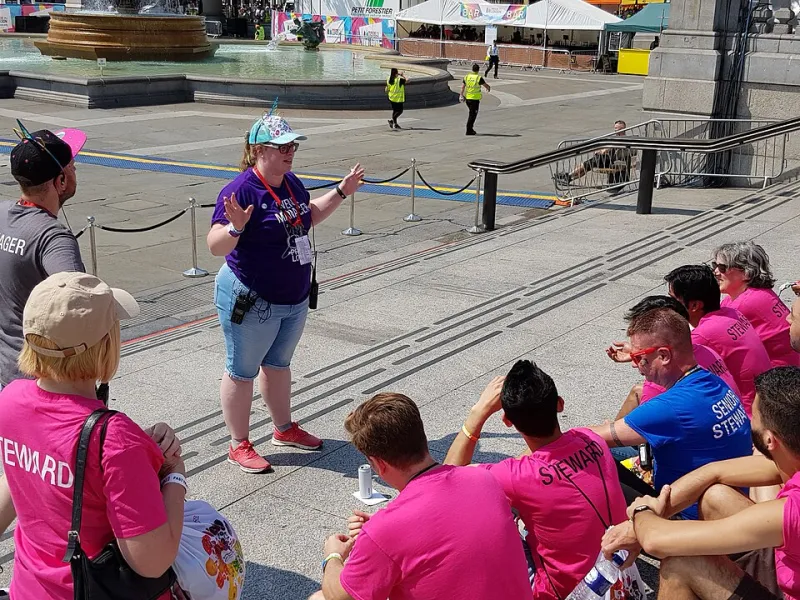
A third pitfall is treating accessibility as the responsibility of a single access officer. In practice, every marshal may be the first person a disabled attendee approaches. Briefings should therefore include simple escalation routes: who to call for welfare, medical or security support, and how to summon a colleague without leaving a gap in the crowd flow.
Keeping the general flow moving
Accessible crowd management does not mean stopping the event around every disabled attendee. It means designing routes and processes that absorb different needs without creating bottlenecks. A well-placed marshal at a crossing point can pause a queue briefly to allow a wheelchair user through, then release it again. A quiet space away from the main stage can reduce sensory pressure without disrupting the programme. Clear signage can prevent people from asking the same question at the busiest gate.
The test is whether accessibility is built into the operation or bolted on afterwards. When it is built in, marshals spend less time firefighting and more time doing what they do best: keeping people informed, safe and moving.
At Marshals Group, our teams are briefed to treat access as part of the crowd plan, not a specialist sideline. In 2026, the standard UK organisers should expect is simple: every attendee should be able to reach the event, move around it and enjoy it with dignity. That is not an added extra. It is the baseline of a well-marshalled event.