The Line in the High Street: Why Marshals Must Not Be Asked to Do Security's Job
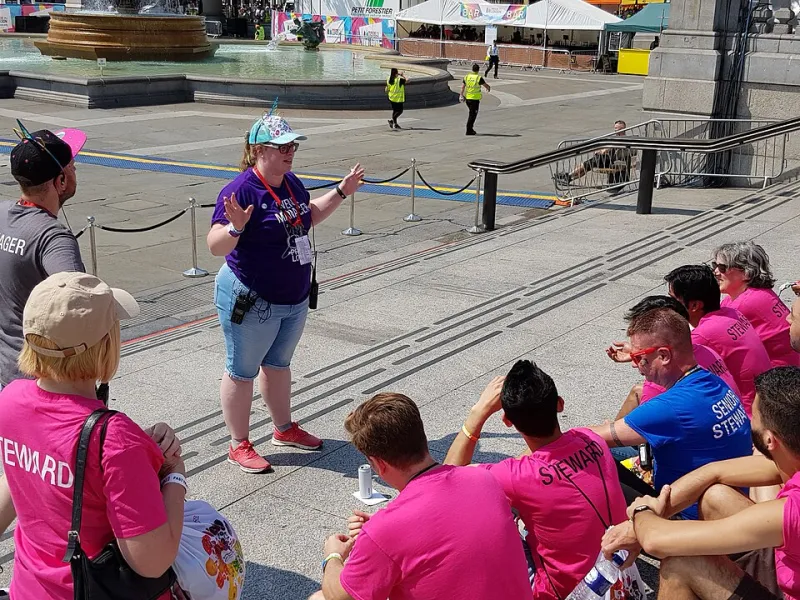
Photo: Fæ, CC BY-SA 4.0, via Wikimedia Commons
The temptation to blur the line
There is a familiar moment in event planning when someone asks whether the marshals can 'just keep an eye on the gate' or 'have a word' with a difficult customer. The request is usually well intentioned. Budgets are tight, the security team is small and the marshal team is already on site. But the distinction between event marshalling and licensed security is not a matter of job title or the colour of a tabard. It is a regulatory boundary with practical consequences for organisers, venues and the public.
Marshals are the eyes, ears and helpful presence of an event. They guide people, manage queues, monitor crowd flow, assist accessibility and report incidents. Licensed security personnel are trained and authorised to perform functions such as guarding premises, controlling access, searching people or bags, and using physical intervention within the law. When organisers ask marshals to cross that line, they are not saving money; they are creating risk.
What marshalling is, and what it is not
Good marshalling is proactive and public-facing. A marshal might direct visitors to the correct entrance, keep a fire lane clear, help a lost child reach a supervisor or ask a queue to move forward safely. They can observe and report. They can request cooperation. They can be a reassuring presence at a busy junction. They cannot lawfully perform licensed security activities simply because they are wearing high-visibility clothing.
The temptation to blur the boundary often appears in small, practical requests. A marshal is asked to search a bag at a market entrance. A steward is told to stand on a door and refuse entry. A supervisor is asked to remove an intoxicated person from a site. Each of these tasks may fall within the scope of licensed security work, depending on the circumstances and the relevant licensing regime. The safe operating assumption is that if a task looks like security, it should be delivered by a licensed security provider or escalated to the police.
The UK regulatory boundary in practice
The Private Security Industry Act 2001 established the framework for licensing many private security activities in England and Wales, and the Security Industry Authority remains the regulator. Door supervision, security guarding, key holding and certain public space surveillance activities are licensed. Local authority licensing conditions, premises licences and event safety advisory group expectations can add further requirements. The precise boundary depends on what is actually being done, not what the rota calls it.
Organisers should therefore describe roles accurately in contracts and briefings. 'Marshal' should mean guidance, information, queue management and reporting. 'Security' should mean a licensed provider with the appropriate SIA licences, insurance and supervision. If an event needs bag searches, access control enforcement, physical intervention capability or close protection of cash or equipment, that requirement should be specified and resourced properly. A mixed team can work well, but only when each member knows exactly which side of the line they stand on.
Escalation protocols that protect everyone
The most useful protection is a written escalation protocol. It should tell marshals what to observe, what to report, who to call and what not to do. A simple sequence works well: observe, report, request assistance and escalate. Marshals should not physically intervene, detain anyone or conduct searches unless they are trained and licensed to do so. They should know the radio channel for security and the point at which police involvement is required.
The protocol should cover common scenarios. An intoxicated visitor refusing to leave is a security or police matter, not a marshal intervention. A missing child is a welfare incident requiring an immediate supervisor and a coordinated search, not a security response. A suspicious package should be reported without being touched, and the area should be kept clear while the emergency services are called. A crowd surge at a pinch point may require marshals to hold and release flow, but physical crowd control and ejection remain security functions. Incident logs should record times, decisions and actions so that the organiser can demonstrate that reasonable steps were taken.
Insurance and contractual checks
Insurance is where blurred boundaries become expensive. Public liability and employer's liability policies may contain conditions, exclusions or warranties relating to security activities. If an insurer concludes that an unlicensed person was performing security work, a claim or coverage position can become far more complicated than the organiser expected. The same applies to contracts that describe a provider as supplying 'marshals' while the site arrangements require security.
Before the event, check that the provider has the right insurance for the actual task, that subcontractors are vetted and that SIA licences are checked where required. Risk assessments and method statements should match the role descriptions. Venues and local authorities may ask for evidence of competence, supervision and insurance, and they are entitled to expect consistency between the event management plan and what happens on the ground. Cheap cover is not good value if it does not respond when something goes wrong.
Drawing the boundary clearly
Clear boundaries also help the public. A marshal who is asked to 'look like security' can create confusion about authority and expectations. Role cards, distinct tabards where appropriate and consistent briefing can make the distinction visible without undermining the team. Organisers should resist the temptation to use marshals as a cut-price security solution. The correct response to a security requirement is a licensed security requirement, not a quiet word to the marshal supervisor.
Marshals do valuable work precisely because they are not security. They keep people moving, answer questions and provide a calm human presence at the point where crowds make decisions. Protecting that role means protecting the boundary. Clear definitions, written escalation protocols and proper insurance checks are not bureaucracy; they are the practical means by which organisers, venues and the public are kept safe.