Reading the Sky Before the Crowd Does: Weather Triggers for UK Outdoor Event Teams

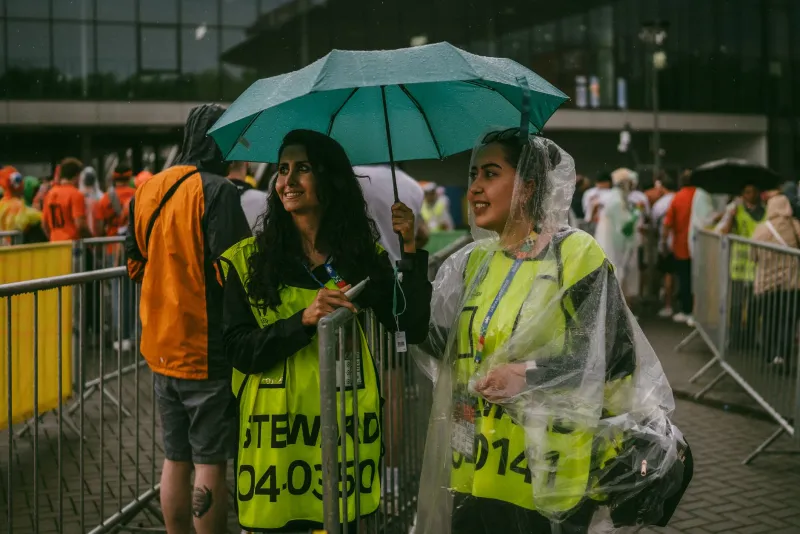
Photo: Matti Blume, CC BY-SA 4.0, via Wikimedia Commons
There is a particular kind of optimism in UK event planning that treats a favourable forecast as a commitment rather than a probability. It survives because it usually gets away with it. Most outdoor events pass without incident, the showers blow through, the wind stays in the treetops, and the contingency plan stays in its plastic wallet. Then comes a summer where the pattern breaks, and the same plan is opened for the first time while the site is already changing around it.
Good weather planning is not about predicting the British climate. It is about deciding, in advance and in writing, at what point the organisation changes what it is doing. A trigger is only useful if it is set before the day, agreed with the organiser, and understood by the people on the ground who will have to act on it.
Forecasts inform; thresholds decide
An anemometer reading or a rainfall radar image tells a supervisor what is happening. It does not tell them what to do. That determination should already exist, agreed at planning stage, expressed in numbers and rehearsed. The difference matters because decisions taken in deteriorating conditions are taken under pressure, by people who are cold, wet or uncomfortably hot, and often with the crowd watching.
When the threshold is pre-agreed, the conversation changes from whether to act to how to act. That is a far shorter and safer conversation.
Setting the numbers that matter
Every event is different, and the thresholds below are illustrative rather than prescriptive. What matters is that a site-specific set is written down, reviewed with the safety officer and licencing authority where relevant, and included in the marshal briefing pack.
Rain. Useful triggers include hourly rainfall rate, the appearance of standing water on designated pedestrian routes, and the loss of grip on grass or temporary track. Once surface water reaches a defined depth on an access route, the response is not a discussion but a diversion. Drainage failure at a specific point should be mapped in advance so that the diversion is known before it is needed.
Wind. Sustained speed and gust thresholds should be set separately, because temporary structures fail on gusts rather than averages. Signage, gazebos, flag banners, fencing panels and inflatable features all have their own limits, usually supplied by the manufacturer. Marshals should know which structures on their patch must be lowered, weighted or removed at each threshold, and who authorises that work.
Heat. Temperature alone is a blunt instrument; humidity, radiant heat and the absence of shade matter more. A workable approach combines a temperature trigger with defined welfare actions: increased rotation, additional water points, shaded rest areas and scheduled welfare checks on staff in exposed positions. Heat illness is cumulative across a shift and is easily mistaken for ordinary tiredness.
Lightning. Distance-based protocols are widely used and should be stated plainly: at a defined distance, activity in open areas is suspended and shelter instructions are issued; after a defined period without further strikes, activity resumes. The protocol must identify who calls it and who communicates it, because the wrong answer is that everyone waits for someone else.
Staff welfare is an operational trigger in its own right
A contingency plan that protects the public but exhausts the workforce will fail on the second day of a multi-day event. Welfare should therefore be built into the trigger table rather than appended to it. Rotation intervals in hot weather, waterproof and warm layers in cold and wet conditions, rest breaks away from the crowd, access to drinking water and a dry space to eat are all operational requirements, not perks.
Supervisors also need permission to act on what they see rather than only on what the forecast says. A marshal showing early signs of heat exhaustion is a trigger for rotation regardless of the thermometer. Fatigue and cold are slower and easier to miss, particularly in the late evening when attention is already stretched.
Signage, shelter and the shape of the site
When a trigger is met, the site itself should change. Pre-printed signage for route diversions, temporary closures and shelter directions should be held at known locations, along with the fixings needed to install it quickly. Shelter points should be identified in advance, mapped, and communicated to marshals in the briefing rather than discovered in the moment.
Evacuation and refuge routes deserve particular attention in poor weather, because the routes that work on a dry afternoon may be unusable once ground conditions deteriorate. Where possible, the flood or mud risk on each route should be assessed at planning stage and an alternative agreed.
The decision log is the most valuable document of the day
Weather decisions are frequently revisited afterwards, particularly where an event has been suspended, a route closed or a structure removed. A contemporaneous log recording the time, the observation, the threshold reached, the decision taken and the person who authorised it converts a contested memory into a record. It takes seconds to write and considerably longer to reconstruct. It also supports the debrief, which is where the next event's thresholds are refined.
Communication with organisers and the public
Triggers should be communicated upwards without delay and downwards in plain language. Event control needs to know the moment a threshold is met, even where the response is routine. Members of the public need to know what is changing and where to go, delivered by marshals who have been given the wording in advance rather than improvising at a barrier. Consistency across positions matters more than elegance; three marshals giving three different instructions erodes confidence quickly.
Rehearsing the triggers before the day
A short tabletop exercise during briefing, using one rain scenario and one wind scenario, will expose most ambiguities. Who calls it? Who tells the public? Where do the signs live? Who signs the log? Teams that have answered these questions once will answer them faster under a darkening sky.
The British weather will always be unpredictable. The response to it does not have to be.