After the Applause: Marshal Duty Behind the Last Runner
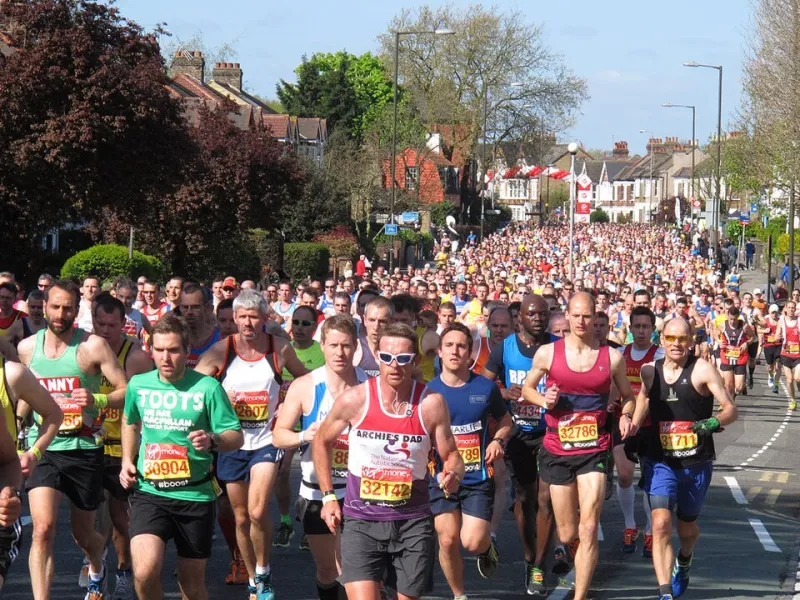
Photo: Stephen Craven , CC BY-SA 2.0, via Wikimedia Commons
Mass-participation running in the UK is often planned from the front. Elite athletes, championship entrants and the main pack shape the start times, the timing systems and the spectator plan. The back of the field, however, is where an event's operational character is most exposed. The last participants may be slower, less experienced, fundraising for a cause, or returning after illness. They are no less entitled to a safe, well-marshalled route. In practice, they are the group most likely to meet a road that is reopening, a water station that has been packed away, or a marshal who has already left post.
The field has a rear
Every mass-participation run has a rear boundary, even when organisers prefer not to name it. That boundary is defined by the sweep team, the race clock and the traffic management plan. It should be planned as deliberately as the start line. A tail marshal who follows the last runner is not a ceremonial extra; they are the moving edge of the event. They need a clear route, communications that hold at walking pace, and the authority to escalate a participant who is unwell or distressed.
Sweeper teams work best in pairs or small groups with defined responsibilities. One may stay with a participant; another may move ahead to the next junction. One carries the link to control; another watches the road behind. The team needs a simple threshold for when to call for medical support and when to encourage a participant to accept transport. These decisions should be rehearsed before the day, not improvised at the kerb.
Cut-offs must be communicated before they bite
Cut-off points are sometimes treated as an administrative detail hidden in race instructions. For the back of the field, they are the central fact of the day. A cut-off is fair only when it is clear, timed and explained in advance. Participants should know not only the time but the consequence: a redirected route, a collection point or a transport option. Marshals at that point need the same script and the same discretion.
The marshal's role is not to argue the merits of a cut-off. It is to apply it consistently and to make the next step easy. That means having a named lead at each cut-off, a record of decisions and a way to move people away from the carriageway without leaving them stranded. A clipboard and a radio are more useful than a loudhailer.
Road reopening needs evidence, not optimism
The public reputation of a mass-participation run is often decided after the winner has finished. Residents want their road back; bus operators want their timetable restored; businesses want access. Reopening should follow a verified sweep, not a hoped-for gap in the field. The sweep team should confirm that the route is clear, that signage is being recovered, and that no participant remains between the last marshal and the closure point.
Where a rolling reopening is used, the handover between race control and the highway authority must be explicit. Marshals should not be asked to make legal decisions about traffic management. They can report, hold and confirm. The decision to reopen belongs to the responsible authority under the agreed plan. A disciplined tail end makes that decision easier because the evidence is already on the radio.
Dignity is a marshalling skill
Slower finishers are not a problem to be cleared. They are participants who may be in pain, embarrassed or close to tears. A marshal who says 'you're nearly there' when there are four miles left is not being kind; they are damaging trust. Better to give accurate information, offer a steady escort where needed, and protect the participant from traffic and from the well-meaning attention of bystanders.
Dignity also means avoiding the spectacle of a public sweep. Where a participant must be collected, the vehicle and the conversation should be kept away from the main flow. The aim is to preserve the person's day as far as possible, not to make an example of a cut-off.
The reputation is decided last
Spectators remember the finish, but participants remember the last mile. A well-marshalled back of field tells the public that the event is organised for everyone, not only for the fast and the photogenic. It also protects the event's relationship with residents and highways authorities, who are more likely to support next year's application when this year's closure ended cleanly.
The tail end is not an afterthought. It is the part of the run where planning, communication and courtesy are most visible. Organisers who resource it properly are not being generous; they are being accurate about what a mass-participation event actually is.