The Kerbside Handover: Coach Arrivals and the Discipline of the Group Drop-Off
A coach arriving at a UK event is not simply a vehicle looking for a space. It is a container of people who will step out together, often into an unfamiliar environment, at a point where the site boundary, the public highway and the pedestrian route all meet. The coach bay is therefore a frontier. On one side sits the ordinary road network; on the other, the controlled world of the event. Marshals who understand that distinction can prevent a routine arrival from becoming a compressed and unpredictable pedestrian moment.
The bay is a pedestrian place first
Too often, set-down is treated as a traffic detail: a lay-by, a coned area, a short window before the coach moves on. That framing misses what actually happens at the kerb. Thirty or fifty people may disembark in less than two minutes, carrying bags, folding chairs, instruments or kit. Some will know exactly where to go. Others will stop, turn around, ask questions and block the step. A few will move in the wrong direction entirely.
The first planning decision is to define the pedestrian footprint of the bay before defining the vehicle footprint. Where will people stand once they are off the coach? Which route leads to the gate, the accreditation point or the group assembly area? Is there a safe waiting place for those whose tickets or wristbands are being checked? If the answer relies on people standing in a live traffic lane, the bay is not yet a plan.
A useful discipline is to walk the bay at the speed of a disoriented visitor rather than the speed of an operations manager. That walk should reveal whether the route is legible, whether the kerb is protected, and whether a marshal can hold a group without standing in the path of the next vehicle.
Set-down and pick-up are different operations
The morning set-down is usually a dispersal problem. People arrive together and need to be moved away from the vehicle quickly and in the right direction. The evening pick-up is a concentration problem. People arrive over a longer period, wait for a coach that may not yet be visible, and tend to gather in the place where they expect to be collected. Treating these as one operation invites conflict.
Set-down should be time-slotted where possible, with a named marshal at the bay and a clear instruction to drivers about where to stop, where to unload and when to leave. Pick-up needs a holding area that is not the carriageway, not the main pedestrian flow and not the front of a residential property. Ideally, it should be visible from the pick-up point so that groups can be moved forward in controlled batches rather than all at once.
Where space allows, separate the two functions entirely. A coach that drops at one point and collects at another reduces the chance of a morning queue becoming an evening obstruction. Where separation is impossible, sequence the operation so that pick-up does not begin until the set-down area has been cleared and re-marked.
Brief the driver before the vehicle reaches the site
A driver who receives instructions only at the barrier has already made most of the decisions that matter. The briefing should begin before departure from the depot or the group's origin. It should state the approach route, the exact bay, the permitted stopping window, the exit route and the contact channel for the marshal on duty. It should also explain why the instructions exist: not to inconvenience the driver, but to protect the group and the surrounding streets.
Drivers should be told what to do if the bay is occupied, if the group is late, or if a passenger needs more time to alight. A second coach arriving early can undo a well-planned set-down unless there is a designated holding point and a clear instruction not to improvise. The same applies to minibuses, which are often overlooked in coach planning despite creating similar kerbside pressures on a smaller scale.
Make group leaders part of the handover
Group leaders are not a substitute for marshals, but they are essential to a clean handover. They know names, mobility needs and the likely behaviour of their group. A short briefing before arrival can turn a leader into a useful extension of the marshalling team: counting passengers off, keeping the group together, directing them to the assembly point and reporting anyone who has not appeared.
The briefing should be practical rather than ceremonial. Give the leader the bay name, the walking route, the meeting point and a contact number. Ask them to prepare passengers before the coach stops, particularly where steps, narrow pavements or dark conditions are involved. If a group includes people with reduced mobility, the marshal should know before the doors open, not after the queue has formed.
Keep the surrounding streets clear
Residential streets near UK event sites are particularly vulnerable to coach improvisation. A driver told to wait for ten minutes may choose a nearby corner; a group told to meet at the main road may gather on a pavement that is too narrow for the footfall. These small decisions accumulate into nuisance, obstruction and, in some cases, a risk to sightlines and emergency access.
Marshals should work with the local highway authority and the event's traffic management plan to identify sensitive streets in advance. Signage should direct coaches to the approved bay rather than relying on local knowledge. Where idling is a concern, the brief should state the expectation clearly and provide a marshal contact for delays. Residents should not have to discover the event's coach plan by watching it unfold outside their windows.
Plan for the handover that goes wrong
No coach bay plan survives a breakdown, a late group or a sudden change in weather without some friction. The test is whether the site has a pre-agreed fallback. A late coach may need a revised slot; a disabled vehicle may need a recovery route that does not cross the pedestrian flow; heavy rain may make the planned waiting area unusable. Each of these should have a named decision-maker and a simple instruction that can be passed to drivers and group leaders without debate.
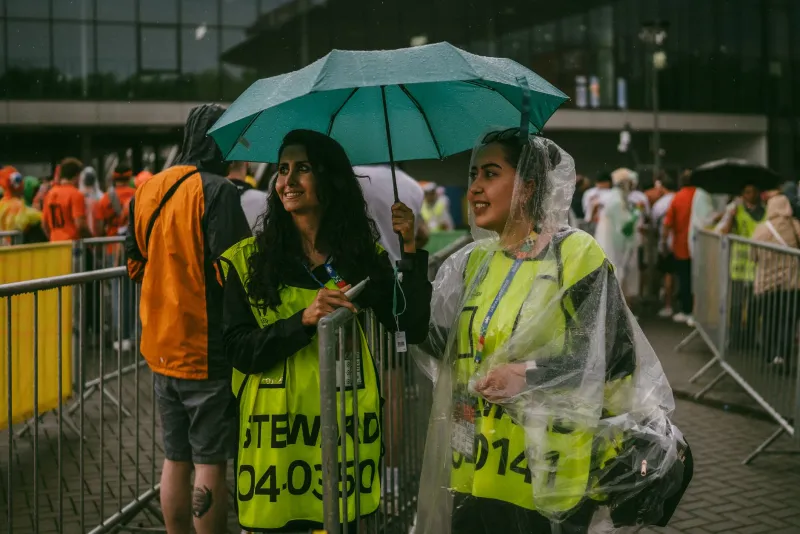
In dark or winter conditions, the kerbside handover becomes harder to read. Lighting, high-visibility clothing and a marshal positioned where drivers can see them become more important than ever. The same applies to surfaces: wet markings, leaf litter and low sun can all turn a familiar bay into an unfamiliar one.
The coach bay will never be the most glamorous part of an event plan, but it is one of the most human. It is where a group first meets the site and where it last leaves it. Marshals Group teams treat that kerbside handover as a controlled operation, not an afterthought, because a calm arrival and a clean departure are often the first and last impressions a visitor takes away.