No Fence, Still a Boundary: Marshalling Crowds on Open UK Ground

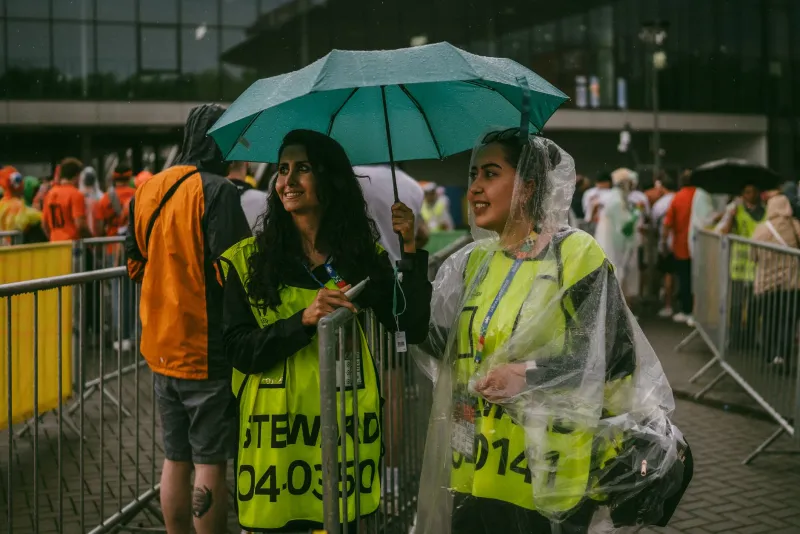
Photo: unfenced country park event crowd marshals temporary signage UK, via www.boredpanda.com
Most UK event plans begin with a line. A fence, a hoarding, a length of barrier track. The line does the arguing: it tells visitors where the event starts, where the ticket check sits, and where the public right of way runs. Take the line away — as happens on common land, country parks, registered open-access ground and the permissive paths that thread through private estates — and the marshal team inherits a harder task. The edge has to be made rather than found.
That does not mean the ground is lawless or that anything goes. It means the boundary is a working agreement, held by people, signage and landowner consent rather than by post-and-rail. Getting that agreement right is a compliance exercise before it is an operational one, and it is where Marshals Group begins when a client briefs an unfenced site.
Map the rights before you map the crowd
The first document is not a site plan but a legal one. Which paths are public footpaths, bridleways or restricted byways? Which land is open access under the Countryside and Rights of Way Act 2000? Where does a permissive path end and a private drive begin? On common land, who holds the common rights, and who manages the grazing?
The answers change what marshals can and cannot do. A public right of way is not an event boundary; it is a route the public may use, and blocking it without a temporary traffic regulation order or a formal diversion is rarely acceptable and often unlawful. A permissive path can sometimes be closed by the landowner for the day, but only with clear permission and clear notice. Country parks often have byelaws; forestry land has its own access arrangements. The working edge must sit inside those rules, not across them.
Landowner liaison is not a courtesy call. It is the source of the edge’s authority. Estate managers, rangers, commoners and local authority countryside officers know where people actually walk, where the ground holds up in rain, and where a temporary sign will be ignored or uprooted. A short walk of the boundary with the person who manages the land is worth more than a page of assumptions.
Let the ground draw the first draft
Natural features are useful because they are already understood. A hedgerow, a dry-stone wall, a ditch, a line of mature trees or a change in slope all read as edges to people who do not read plans. The mistake is to assume they read the same way to everyone. A gap in a hedge is an invitation; a stile is an invitation with a handle. A low bank that stops a tractor will not stop a family with a pushchair looking for a shortcut.
Walk the site at the times visitors will arrive. Note the desire lines — the worn grass, the flattened nettles, the places where a fence has been pushed down before. Those are the points where a notional boundary will leak. They are also the places where a marshal post earns its keep.
Signage should explain, not pretend
Temporary signage on open ground has one job: to make the working edge legible without pretending it is a legal wall. Wording matters. “Event site — please use the main entrance” is honest and usually obeyed. “No entry” on land where the public has a right to be is an argument waiting to happen, and it puts marshals in a position they should not occupy.
Signs should agree with each other and with the map handed out at the gate. In Wales, bilingual signage is part of doing the job properly. At junctions, a single clear board beats a cluster of contradictory ones. Face signs towards the approach, not the event, and put them where someone will actually stop to read — beside a gate, at the top of a slope, at the point where a path meets a car park.
The post is the edge
Where the ground gives no line, the marshal does. Posts should be placed on sightlines, with overlapping views, so that a visitor who slips past one is met by another rather than by empty ground. Brief the team on the reason for the edge, not just its coordinates: what lies beyond it — a live arena, a vehicle route, a steep bank, livestock — and what to do when someone insists.
The default response is conversation, redirection and, where necessary, escalation to a supervisor or the landowner’s representative. Marshals are not there to enforce byelaws or to restrain people. They are there to make the sensible route the obvious one. A calm explanation at a gap in a hedge prevents more incidents than a barrier ever will.
Hold the difficult places separately
Every unfenced site has two or three places where the edge matters more than anywhere else: a path that runs close to water, a verge beside a fast road, a slope above a working area, a gate into a field with livestock. Treat those as separate posts with their own brief, not as part of a general perimeter. Physical measures — temporary fencing, cones, a vehicle as a block — can support a marshal at a pinch point without turning the whole site into a fortress.
Close the loop afterwards
Record where the edge held and where it leaked. Note the signs that were moved, the gaps people used, the conversations that recurred. Return the ground to its everyday state and thank the people who allowed the event to borrow it. The next unfenced site will have the same lessons, and the team that writes them down will start further ahead.
An unfenced event is not an unmanaged one. It is an event where the boundary is a piece of work rather than a piece of infrastructure — and where the marshal team, the landowner and the public are all part of how it holds.