The Waiting Ground: Marshalling UK Event Queues With Care and Control
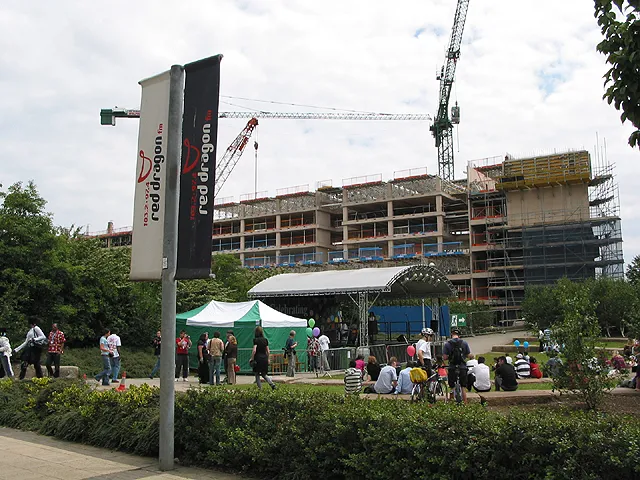
Photo: Pauline Eccles, CC BY-SA 2.0, via Wikimedia Commons
Queues are rarely the part of an event that anyone sets out to design. They are what happens between the car park and the gate, or between the station and the arena, and too often they are treated as a strip of ground to be filled rather than a live operation with its own risks. Yet for many ticketed events in the UK, the queue is the first sustained experience a visitor has of the event team. It is also, for some, the longest. A well-run line sets a tone of competence and fairness; a poorly run one can turn an otherwise good day into a test of patience before the programme has even begun.
The queue as a temporary high street
A queue is not a static object. It breathes as arrivals gather, stalls when ticket checks slow, and spills into roads, car parks or neighbouring premises when it is not contained. The most useful mental model is a temporary high street: it needs a clear route, visible landmarks, a beginning and an end, and enough space for people to wait without feeling penned in. That framing helps event teams move beyond the idea of queue management as a few barriers and a steward at the front. It becomes a planning task involving arrival curves, ground conditions, signage, staffing and contingency.
At Marshals Group, the operational view is straightforward. If the waiting ground is designed well, marshals spend less time correcting confusion and more time helping people. If it is designed poorly, every marshal becomes a human signpost for a system that should have explained itself.
Layout that explains itself
Snaking layouts are common because they concentrate a long line into a compact area, but they only work when the geometry is legible. Switchbacks should be wide enough for two people to pass comfortably, with turns that do not encourage cutting. Bay lengths should be calculated from realistic arrival rates rather than guesswork, and the line should avoid crossing other pedestrian flows, emergency access routes or vehicle movements.
Ground markings, rope and barriers do much of the quiet work, but they need to be placed at decision points rather than scattered along the route. A visitor should be able to see where the line begins, where it turns and roughly how far it extends. Where the queue runs beside a road or a busy town centre footway, physical separation matters. So does drainage and surface condition: a line that turns into a muddy channel after a British weather front will erode goodwill faster than almost any delay.
Merge points are where goodwill is won or lost
Most queue friction occurs where two lines meet. A family arriving from one entrance, a group from another and a late arrival trying to join the shortest-looking strand can create confusion in seconds. Merge points need a dedicated marshal, a clear rule and a consistent visual cue. The instruction should be simple enough to repeat under pressure: join here, keep the lane clear, follow the person in front.
Controlled release is usually better than an open merge. Releasing small groups at a time keeps the line moving evenly and reduces the temptation to push forward. The marshal at the merge should stand where they can see both approaches and be backed by signage that does not contradict them. If priority lanes exist for accessible guests, families with young children or pre-booked entry, the merge point must make those routes obvious without making other visitors feel penalised.
Signage, wait times and the honesty test
Signage is often treated as decoration. In a queue, it is part of the operating system. Entry signs should state the route and any category-specific lanes. Intermediate signs should give reassurance that the line is moving and indicate facilities such as toilets, water points or accessible assistance. Dynamic wait-time boards can help, but only if the information is credible. A board that promises ten minutes when the line is visibly much longer does more damage than no board at all.
Honest estimates, updated at sensible intervals, give visitors the chance to make decisions. They can visit a concession, return to the car or ask for assistance. Marshals should be briefed on the current estimate and given a simple script for uncertainty. Phrases such as the team is working to bring the wait down and we will update you shortly are more useful than invented precision. The aim is not to make waiting enjoyable; it is to make it predictable.
Accessible and family routes are not add-ons
Accessible entry should be planned as a distinct route, not as an afterthought bolted onto the side of a snaking pen. Visitors with mobility needs, sensory sensitivities or medical requirements may not be able to stand for long periods in a confined line. A separate assisted-entry lane, clearly signed and staffed by a marshal briefed on its purpose, reduces distress and prevents avoidable conflict at the main gate.
Families with young children need similar consideration. Buggy space, access to toilets and a route that does not require repeated lifting over barriers are practical matters, not privileges. Where a family lane is provided, it should be visible from the approach and managed with the same discipline as the main queue. Marshals should know how to redirect someone politely if they join the wrong lane, and they should have a supervisor to call if a situation needs more authority than a steward can reasonably provide.
Order without confrontation
Queue marshals are not security. Their role is to guide, reassure and maintain flow, not to physically intervene or adjudicate disputes. That boundary should be explicit in briefing. A marshal who feels responsible for stopping a queue jumper may put themselves at risk; a marshal who knows how to escalate quickly keeps the situation calmer.
Good practice starts with positioning. Marshals should stand slightly to the side of the flow, not directly in it, and use open gestures rather than pointing. Short, neutral scripts help: the line starts here, please keep this lane clear, a supervisor is coming to help. If someone becomes aggressive, the marshal should step back, avoid a debate and call for support. Incident details should be recorded while they are fresh. The event security team handles enforcement; the marshal team handles the experience.
Rotation, welfare and the peak arrival window
The peak arrival window is usually the most demanding part of the day, often in the hour or so before the main programme begins. Marshals standing in one position for too long lose concentration and patience. Rotation every thirty to forty-five minutes, with a float marshal covering breaks, keeps the line supervised without exhausting the team. Water, shade in summer and warm layers in winter are basic welfare provisions, not extras.
Supervisors should watch the queue rather than only the gate. A line that has stopped moving, a merge point that is backing up or a group gathering without direction are early signals. Radio traffic should be concise and focused on flow, welfare and escalation. Where communications are patchy, pre-agreed hand signals or runner routes should be in place before the gates open.
Knowing when a line exceeds a marshal's remit
There are moments when a queue needs more than a marshal can give. If waiting times pass the agreed threshold, if the line blocks an emergency route, if crowd density becomes uncomfortable or if tempers are rising across several points at once, the marshal team should escalate to the event control room. The response may be to open additional lanes, slow arrivals at the source, deploy security or pause entry briefly. Marshals should not improvise structural changes to the queue without authorisation.
A clear trigger list, agreed in advance, turns a stressful judgement into a shared procedure. It also protects the team. The question is not whether a marshal can hold the line for another ten minutes; it is whether the line is still within the conditions the event plan was designed for.
A first impression worth planning
The queue may not be the headline attraction, but it is part of the event. Visitors will remember whether they felt informed, safe and fairly treated before they reached the gate. That memory is shaped by layout, signage, merge discipline and the conduct of the marshals on the ground. Treating the waiting ground as a designed space, with its own roles and escalation points, is a modest investment with a disproportionate effect on the day. Good queues are not accidental. They are planned, staffed and reviewed like any other part of operations.